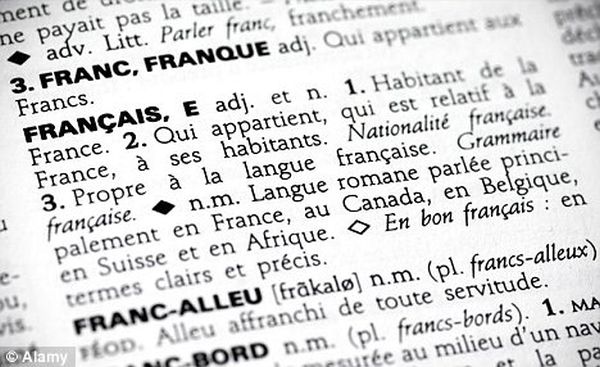
Algerians and Moroccans speak French with a unique crescendo. It is more pronounced than the usual muffled and mellifluous Sorbonne French. Out of 24 francophone countries, an estimated 120 million people speak French in Africa. A sudden switch from Semitic Arabic to Latin French was certainly too harsh on Africans. So it took decades for them to be able to pronounce French ‘R’ which was something closer to Arabic ‘G’. Liaisons and inflections were even harder and subtle to grasp. Depending on your natural inclinations and economic necessities, French could become a matter of life and death.
Ironically post-revolution France was not made iconic by an aristocratic and savant Jacobin but by someone who couldn’t learn to spell French for most of his life and spoke with a heavy Corsican accent influenced by its Italian neighbor. Surrounded by green and blue waters, island of Corsica is a free territory of France. Its Genoese watchtowers and serene climate is nothing by poetic. This is where Ali Bonaparte was born. There was only so much nobility one could possess in this French island during the last half of 18th century but for what it was worth, Carlo Buonaparte was born into it. Born Napoleon Bonaparte didn’t grow up to like France at all. He was a staunch nationalist who hatedFrench with all his heart and soul. He considered his father a man of chameleon-like loyalty to France, something that would make him a ‘traitor’ for rest of his life in his son’s memories. Like all praetorian people, Carlo had to make sure his line prospered under French tutelage. He was sent to France to study where a scholarship was arranged for him at the Royal college of the military. He did extremely well at school. His teachers expected great things from him and his classmates were inspired however Napoleon himself stayed aloof and cold. There was little charm in French and grandeur of possibilities that a man of his stature could explore was a constant source of distress to the lonely Corsican.
Well into late years of the French revolution, Napoleon was disoriented although ambitious. It was only in 1796 that his life crossed paths with Josephine de Beauharnais, widow of a guillotined army officer. History would remember them a couple with interests worlds apart. An avid collector of roses Josephine concerned herself with the happiness of her huge garden in Chateau de Malmaison. Napoleon was fastidious and optimistic war-monger that had little time for cultivating the land he ravaged. Soon after his marriage, he departed to Italy where his meteoric rise to the hall of fame began. He literally crushed an army far stronger and well-trained than his own. His comrades would consider him a short, rough and quiet man nonetheless with the ability to inspire tremendous fear in his subjects. His pincer movements are taught in war colleges today as a testimony to his military genius. He sieged, concealed, intercepted and decimated his enemies from places they couldn’t dream of. His maneuvers were unique, excruciating and insurmountable. He was nothing but the wrath of god himself.
His newly acquired fame gave him the strength to execute a plan bigger than himself and yet something that would change his life forever. In order to cut the English naval route to India, he invaded Egypt. By then, European military technologies had by far outdated the Ottoman war machine and taking out Alexandria was easy. At the battle of Pyramids, 29 French soldiers died after a sanguine slaughter of 2000 Egyptians. It was less the victory that bewildered Napoleon but his new victims. Baptized as Christian he was thoroughly taken aback by Islamic culture and its uprightness. What he saw belied his extensive readings and experiences back home. He despised Voltaire for character assassination attempt of the Muslim prophet in his play ‘Mahomet’ ﷺ. He called him a fanatic. He started dressing as Muslim, ate Muslim food, had a thorough knowledge of Hadith and Quran and addressed people with erudite Islamic knowledge.
Napoleon’s biographer Emmanuel-Augustin-Dieudonné-Joseph, count of Las Cases narrates his speech in front of Egyptians where he converted to Islam and changed his name to Ali Bonaparte. He said
“In the name of God the Beneficent, the Merciful, there is no other God than God, he has neither son nor associate to his rule. On behalf of the French Republic founded on the basis of liberty and equality, the General Bonaparte, head of the French Army, proclaims to the people of Egypt that for too long the Beys who rule Egypt insult the French nation and heap abuse on its merchants; the hour of their chastisement has come. For too long, this rabble of slaves brought up in the Caucasus and in Georgia tyrannizes the finest region of the world; but God, Lord of the worlds, all-powerful, has proclaimed an end to their empire. Egyptians, some will say that I have come to destroy your religion; this is a lie, do not believe it! Tell them that I have come to restore your rights and to punish the usurpers; that I respect, more than do the Mamluks, God, his prophet Muhammad and the glorious Quran… we are true Muslims. Are we not the one who has destroyed the Pope who preached war against Muslims? Did we not destroy the Knights of Malta, because these fanatics believed that God wanted them to make war against the Muslims?”
As he presided over Muslim festivals and holy days, he ordered the establishment of religious schools, arranging marriages between the French army and Muslim women after their conversion and learning the oriental culture. Many argue this was an attempt to fulfill the spiritual void that Jacobin libertines created by purging Christianity out of France. Others believed it was a political stunt to win hearts of the conquered. Juan Cole mentions that Napoleon’s admiration of Prophet ﷺwas genuine. He could gain very little from entangling himself into something would pay little materially. His army was far more advanced in war making and Ottoman hold of Egypt was already ceremonial. English had already colonized places far away without converting to the host’s religion. There is little to doubt his sincere conversion to Islam. Newspapers in France and England both know this. While English hid the fact at times and painted it as Franco-Ottoman ruse against English supremacy at others, it didn’t lead to an academic understanding of another religion. On the contrary, the publicity in English newspapers incited a crusade against Islam by subsequent translation and dissemination of this in other European countries.
Napoleon’s return to France was a new era in French history. Napoleon’s Code had not Islamic influence and republicanism but also his internal world had been shaken by the new found truth. Bit by bit he’d use his new learning to ascend in his career. He carried the day at Austerlitz, married Marie Louise and debilitated in the Russian campaign. He got surrounded by enemies, got defeated and abdicated. He was exiled to Elba only to spent some time trying to convince himself of an ordinary life. Failing to do so, he escaped, rallied the troops and become the ruler again. This fall and the subsequent rise is remarkable in its own rite. His long political life, however, was on a short leash. Waterloo became his decisive loss. This time, British took no risk and exiled him to the remotest island in South America, Saint Helena. Heavily guarded island with ships on patrol around it, this had to be his resting place forever. It is here that he confided his long conversations with General Gourgand, his lifelong companion. Before he breathed his last Ali Bonaparte said “The Mohammedan religion is the finest of all.”

