
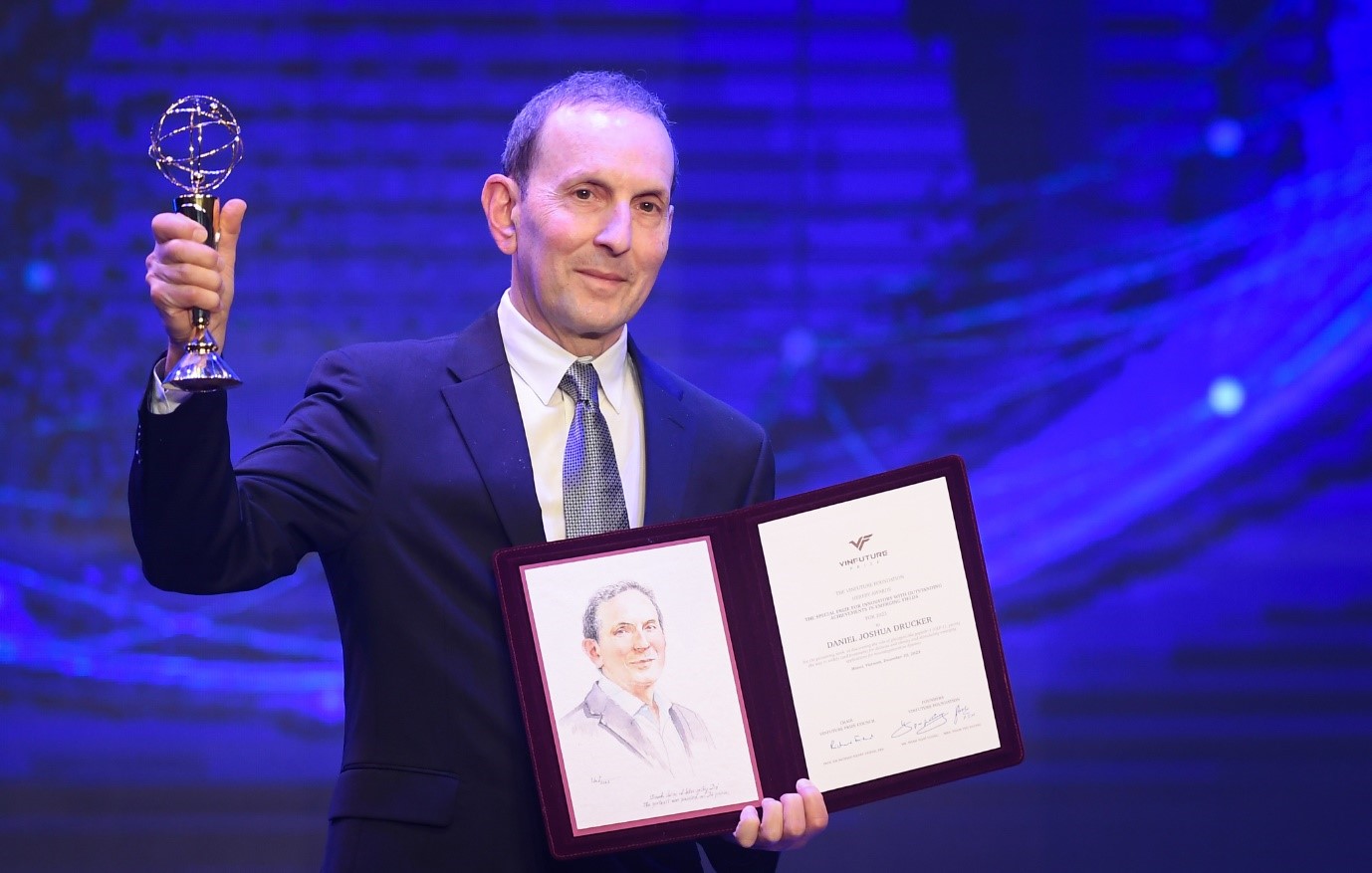
HANOI, VIETNAM – Media OutReach Neswire – 14 April 2025 – Together with world-renowned scientists including Prof. Joel F. Habener, Prof. Jens Juul Holst and Assoc. Prof. Svetlana Mojsov, Prof. Daniel Drucker at the University of Toronto and the Lunenfeld-Tanenbaum Research Institute, has discovered the role of glucagon-like peptide-1 (GLP-1), leading to life-changing therapies for people with diabetes and obesity while stimulating emerging applications for neurodegenerative diseases. This groundbreaking innovation has garnered significant recognition for him and the GLP-1 research group, exemplified by the prestigious 2023 VinFuture Special Prize for Innovators with Outstanding Achievements in Emerging Fields, and the 2025 Breakthrough Prize in Life Sciences, awarded earlier this April.
Prof. Daniel Drucker, 2023 VinFuture Special Prize Laureate for Innovators with Outstanding Achievements in Emerging Fields, continues to receive recognition with the 2025 Breakthrough Prize in Life Sciences
In this interview, he reflects on the impact and influences of the VinFuture Prize on his further research, as well as the challenges and prospects of expanding GLP-1 accessibility. As global scientific recognition continues to evolve, he shares insights into the vital role of initiatives like the VinFuture Prize in inspiring the next generation of scientists.
VinFuture: Recognizing transformative science
The 2023 VinFuture Prize holds the distinction of being the first major international science and technology award to recognize and honor the scientists behind the discovery of the role of GLP-1. Following the VinFuture Prize, the GLP-1 research group has continuously received recognitions with numerous other prestigious accolades, including their listing among the 2024 Time 100 Most Influential People.
Reflecting on this, Prof. Drucker expressed deep appreciation, noting that these awards provide invaluable support in pushing the boundaries of scientific discovery.
“As the VinFuture Prize gains prominence, having GLP-1 science acknowledged as a recipient also helps elevate the global understanding of how it can transform healthcare,” he emphasized.
Continuing its commitment to recognizing impactful advancements, the 2024 VinFuture Prize honored innovators in the biomedical field for their development of CAR T-cell therapy for cancer and other diseases. According to Prof. Drucker, this innovation stands as “a remarkable example of how immunological science can revolutionize the treatment of many cancer types.”
“With the honoring of AI and CAR T cell therapy, the trends I observe are consistent with other international awards, where similar innovative themes are celebrated around the same time or within a few years. This alignment reinforces the importance of these breakthroughs.” Prof. Drucker commented.
Among the youngest international science-technology awards, now in its fifth year, the VinFuture Prize is steadily establishing its significance and reputation, evidenced by the increasing number of laureates continuing to receive recognition from prestigious international awards, most notably the Nobel Prize. Prominent examples include Dr. Katalin Karikó and Prof. Drew Weissman (Laureates of the 2021 VinFuture Grand Prize and 2023 Nobel Prize in Physiology or Medicine), Dr. Demis Hassabis and Dr. John Jumper (Laureates of the 2022 VinFuture Special Prize and 2024 Nobel Prize in Chemistry), and Prof. Geoffrey Hinton (Laureate of the 2024 VinFuture Grand Prize and 2024 Nobel Prize in Physics).
“Despite being a relatively new award, the VinFuture Prize has done an exceptional job of highlighting high-quality science. The recognition of AI, coinciding with its recent recognition by the Nobel Prize, highlights its transformative impact on numerous aspects of society,” Prof. Drucker said. “So I think the VinFuture Prize council really has its finger on the leading edge of science in many areas.”
Beyond diabetes
2024 was a landmark year for GLP-1 research, with several exciting clinical trials demonstrating benefits extending far beyond obesity to include the treatment of patients with heart disease, obstructive sleep apnea, and knee osteoarthritis. Additionally, Prof. Drucker hinted at early promising results for patients with metabolic liver disease and noted ongoing studies exploring GLP-1’s effects on Alzheimer’s disease, with results expected soon.
“The continuous wave of new findings will provide deeper insights into the full potential of GLP-1-based therapies.” Prof. Drucker commented, stating that each study will contribute to refining our understanding of this science.
Furthermore, Prof. Drucker highlighted GLP-1’s neurological effects and its potential clinical application in addressing mental health conditions, including anxiety, depression, and compulsive behaviors. He noted that preliminary, early-stage trials with small patient groups investigating GLP-1’s potential in reducing cravings and treating addiction-related disorders have yielded promising initial results.
“Several academic research centers are actively studying GLP-1’s effects on substance use disorders, and major pharmaceutical companies such as Eli Lilly and Novo Nordisk have begun clinical trials to explore these applications further.” Prof. Drucker shared, “It will likely take 12 to 18 months before we gain a clearer picture of whether these medicines can be clinically effective in helping individuals reduce or quit substance use.”
Prof. Drucker also highlighted compelling research indicating GLP-1’s interaction with the brain, extends beyond appetite regulation, suggesting a range of potential therapeutic applications.
“Ongoing trials are underway in people with substance use disorders, including alcohol, nicotine, cannabinoids, and opioids, conditions for which existing medicines are not always very effective.” He elaborated, “We have trials underway for Alzheimer’s disease with oral semaglutide, which are expected to conclude by the end of 2025. These investigations will significantly enhance our understanding of GLP-1’s neurological impact and potential clinical applications.”
Overcome barriers to maximize impact
Despite the global excitement for the “Ozempic era”, there are many challenges hindering the widespread impact for GLP-1 medicines. These include the current high cost and limited accessibility of the treatments, the reliance on primarily two main drug options (semaglutide and tirzepatide), and the practical limitations of refrigeration and pen-based delivery for most formulations, as Prof. Drucker pointed out.
“A key priority is the democratization of these treatments so that everyone who could benefit from them has access. To achieve this, we are working on small-molecule pills that are easier to manufacture and should be more affordable.” He explained.
Prof. Drucker anticipated that increased competition in the GLP-1 market will lead to lower prices, development of newer versions that are easier to use, including once-monthly injections, thereby improving accessibility and convenience for millions worldwide.
“Most initial launches have occurred in countries with well-established healthcare and reimbursement systems. Only now are we seeing manufacturing capacity expand enough to increase availability, but costs remain a significant barrier.” He stated, emphasizing the critical need to advance these medicines not only to enhance their efficacy in areas like weight loss and cardiovascular health but also to make them more convenient to take, more affordable, and more broadly accessible to patients globally.
Another major challenge that Prof. Drucker identified is determining the appropriate dosage for extending the therapeutic applications of GLP-1 to conditions beyond diabetes and obesity. While the dosage effective for weight loss may not be suitable for other disorders like Parkinson’s, Alzheimer’s, alcohol use disorder, anxiety, or depression, understanding the dose-response relationship for these conditions requires time and further investigation.
Additionally, research is underway to reduce adverse effects, making GLP-1 treatments safer and more comfortable for patients. Prof. Drucker elaborated, “One key strategy is starting patients on very low doses and gradually increasing them to minimize side effects. Additionally, some companies are researching ways to reduce further adverse effects, such as developing co-formulated anti-nausea compounds to improve tolerability.”
Future research for GLP-1 therapies presents numerous possibilities; however, the translation from research to clinical application for neurodegenerative and substance use disorder treatments still presents unmet needs with a lack of evidence for progress. According to Prof. Drucker, with clinical trials underway, they may yield valuable insights within the next 12 to 24 months regarding the potential extension of GLP-1 therapy benefits from glucose control to complex disorders of the central nervous system.
He identified, “The key lies in understanding how to effectively engage the brain, identifying which regions can respond to GLP-1 signaling, and how to optimize that communication.”
In conclusion, Prof. Drucker highlighted the promising contemporary landscape of scientific research, emphasizing the crucial need to inspire the next generation to embrace science and pursue research careers. In this context, the 2023 VinFuture Special Prize Laureate commended the VinFuture Prize for its valuable contribution in motivating individuals within the scientific community and engaging younger generations in science.
“When we visited Vietnam, we met with many young scientists, and I was impressed by VinFuture’s strong efforts to inspire and connect with them. I encourage VinFuture to continue and expand these efforts because investing in young talent is the key to a future filled with groundbreaking innovations.” He stated.
The issuer is solely responsible for the content of this announcement.
VinFuture
The VinFuture Foundation, established on International Human Solidarity Day on December 20th, 2020, is a non-profit organization co-founded by billionaire Mr. Pham Nhat Vuong and his wife, Mrs. Pham Thu Huong. The Foundation’s core activity is awarding the annual VinFuture Prize, which recognizes transformative scientific and technological innovations capable of making significant positive changes in the lives of millions of people worldwide.
The nomination period for the 2025 VinFuture Prize will close at 2:00 PM on April 17, 2025 (Vietnam time, GMT+7). Submit your nominations here: https://vinfutureprize.org/vinfuture-prize-nomination/. Outstanding nominators will be honored through the VinFuture Nominator Recognition Program.The VinFuture Prize consists of four prestigious awards presented each year. The most esteemed is the VinFuture Grand Prize, valued at US$3 million, making it one of the largest annual prizes globally. Additionally, there are three Special Prizes, each valued at US$500,000, specifically dedicated to honoring Women Innovators, Innovators from Developing Countries, and Innovators with Outstanding Achievements in Emerging Fields.
Priced from as low as one-third[1] the cost of a traditional critical illness (CI) plan, the FWD Big 3 CI plan offers one-time full pay-out upon diagnosis of any cancer, heart attack or stroke — which collectively account for 90% of all CI insurance claims in Singapore
SINGAPORE – Media OutReach – 29 July 2020– FWD Singapore (“FWD”) has launched a first-in-market insurance plan – Big 3 Critical Illness Insurance – that offers working adults comprehensive financial protection against three leading causes of death — cancer, heart attack or stroke — that together account for 90% of all critical illness (CI) insurance claims in the country.
This newly created plan is available from as low as one-third[1]the cost of a traditional CI insurance policy, providing a more affordable choice for working adults in Singapore. For example, a 35-year-old non-smoking male can get S$50,000 of coverage from as low as S$18 a month. According to a study[2] published by the Life Insurance Association (LIA) in 2018, a patient diagnosed with a critical illness requires at least S$316,000 to cover family needs and support recovery that would take approximately five years. However, the study revealed that the average critical illness coverage for a working adult in Singapore is just S$60,000, or about 20% of the recommended coverage. FWD Singapore offers this new Big 3 Critical Illness Insurance plan — which is available in three coverage sums of $50,000, $100,000 and $200,000 — aiming to help Singaporeans plug the shortfall in their CI protection gap.
Sociologist Tan Ern Ser attributed this worrying protection gap to the heavy financial constraints and pressures faced by many working adults in Singapore. Associate Professor Tan, who researched on family issues and social policies at the National University of Singapore, explained, “I believe most people would like to have adequate critical illness insurance cover, but they don’t, or feel, they don’t have enough disposable income to pay for all sorts of insurance, important as they are, and this is most likely because they have multiple financial commitments, such as to parents and children, and servicing housing loans.”
Against this worrying backdrop, FWD Singapore CEO Khor Kee Eng said, “The Big 3 Critical Illness Insurance offers all working adults an affordable solution and an important safeguard for their dependents, young and old. As the LIA study clearly states, inadequacy in critical illness insurance coverage among them can lead to significant social and economic impact for their loved ones, especially given the prevalence of cancer, heart attack or stroke in Singapore. We will continue to ride on our customer-led approach to innovate more easy-to-understand products to support Singaporeans.”
Cancer is the leading cause of death in Singapore, with one in five Singaporeans likely to contract a form of the disease in their lifetime, while an average of 17 lives are lost to heart diseases or stroke every day, according to 2018 statistics from the Singapore Heart Foundation.
WHAT IS FWD BIG 3 CRITICAL ILLNESS INSURANCE?
The FWD Big 3 Critical Illness Insurance plan is a protection policy that provides coverage for heart attack, cancer and all stages of cancer. Insured customers will receive a one-time full pay-out of the insured sum upon diagnosis of any of the three diseases, to enable them to focus on recovery and taking care of their financial commitments and those of their loved ones. The other key features of the product are:
No medical examination — The application process can be completed fully online at www.fwd.com.sg. Applicants need only to answer one health declaration and does not require medical examination like applying for traditional CI plans.
Comprehensive yet affordable protection — A 35-year-old non-smoking male can get S$50,000 of coverage from as low as S$18 a month.
Guaranteed cover up to age 85 — Residents between 18 and 65 years old (both inclusive) with a valid NRIC or FIN number can buy the FWD Big 3 Critical Illness Insurance, with the guaranteed option to renew up to age 85.
Death benefit — In the event of death, we pay a lump sum benefit of S$20,000.
All stages of cancer — FWD is the first digital insurer that offers full pay-out for all stages of cancer.
Enhanced coverage with riders — Guaranteed one-time full pay-out should you suffer from or require procedures from any of the 24 covered heart and neurological conditions that affect your brain (11 conditions) or heart (13 conditions) function. These include coronary artery disease and bacterial meningitis.
Kee Eng added, “For insurance, the moments of truth come in three areas, namely the affordability and extent of coverage, the ease of the application process and most crucially, the ease of making a claim. We believe the Big 3 Critical Illness Insurance satisfies all three criteria and clearly demonstrates how FWD is changing the way people feel about insurance in Singapore.”
[1]Information correct as of 25 June 2020 according to internal proprietary research. Base plan comparison is for All stage Cancer, late stage Stroke and late stage Heart attack against similar plans (not identical) in the market.
FWD Group spans Hong Kong & Macau, Thailand, Indonesia,
the Philippines, Singapore, Vietnam, Japan and Malaysia, offering life and
medical insurance, general insurance, employee benefits, Shariah and Family
Takaful products across a number of its markets.
FWD is focused on creating fresh customer experiences, with
easy-to-understand products, supported by digital technology. Through this
customer-led approach, FWD aims to become a leading pan-Asian insurer that
changes the way people feel about insurance.
Established in Asia in 2013, FWD started operations in
Singapore in 2016 and is the insurance business of investment group, Pacific
Century Group. For more information please visit www.fwd.com.sg